The “Operational Scaling Wall”

INDUSTRY
Transportation & Logistics
REGION
Global
SERVICES
autonomous electric trucks
Teams
Operations, Customer Support, Fleet Management
Ready to start?

Success Metrics:
Connect Rate
99.8%
ANNUAL COST SAVINGS
$65,000 Saved
TOP ACHIEVEMENT
Faster Issue Resolution
The “Operational Scaling Wall”
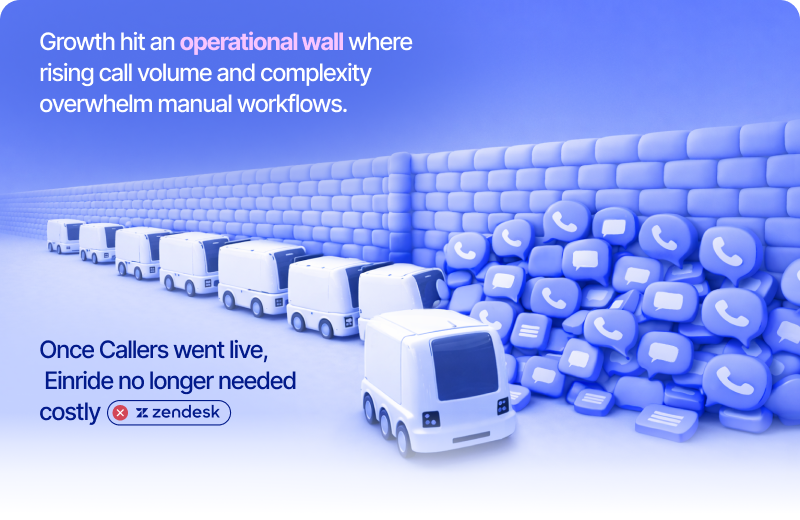
Einride is building the future of freight with electric and autonomous trucks operating across North America and Europe. As the company expanded its carrier-led model, inbound communication from drivers increased dramatically. What were once occasional maintenance calls became constant operational touchpoints involving dock delays, load status, container releases, and real-time issue resolution.
The growth was exciting, but it exposed a bottleneck. Einride’s customer service and operations teams were absorbing more calls, more complexity, and more urgency than their existing workflows could handle.
The Scale Problem
As call volume increased, Einride’s teams were forced to manage multiple responsibilities at once. Support reps were answering inbound calls, collecting issue details, creating tickets, coordinating vendors, and manually tracking loads across different systems.
Maui, Director of Customer Service at Einride, described how tracking and tracing was still largely manual. Reps were doing their best to keep up, but as volume continued to rise, it became clear that this approach would eventually require a dedicated team just to handle tracking alone.
Headcount was not a sustainable answer.
At the same time, Einride was relying on Zendesk as part of its support stack. While widely used, it was expensive and did not meaningfully reduce operational friction. Tickets were duplicated across systems, workflows were fragmented, and the return on investment did not justify the cost.
The math simply did not add up.
“we were manually track it. Our reps do a lot of different things, and at some point, we would need a specific team just to track and trace shipments.”

Annual Savings
$65K+

Saved 24/7
Agent Coverage

99.8%
Connection Rate
The Solution
Einride realized they needed more than a traditional support tool. They needed an intelligent operational layer that could sit in front of their workflows, absorb volume, and structure information before humans got involved.
They broke the solution down into three phases: strategic selection, rapid implementation, and workflow automation.
Strategic Selection
Einride began evaluating Voice AI as a way to scale operations without sacrificing service quality. The objective was not to remove humans from the loop, but to automate the repetitive, high-volume interactions that were slowing teams down.
Chelsea Thompson, Director of Operations at Einride, explained the core challenge clearly. “We needed a scalable way to manage high call volumes without sacrificing customer experience or putting additional strain on our operations team.”
Callers stood out due to its ease of integration, flexibility in workflow design, and highly responsive team. The ability to move quickly and adapt the system to real operational requirements was a decisive factor.
Rapid Implementation
Callers was deployed as the first point of contact for inbound driver calls. From day one, calls were answered instantly, twenty-four seven, without queues or delays.
Drivers were guided through natural conversations designed to capture mandatory information such as truck number, location, issue type, and urgency. Instead of agents spending valuable time gathering context at the start of every call, that information was already structured and ready.
"The speed to value surprised us. We were up and running faster than expected and started seeing measurable results within the first week."
Workflow Automation
Once information was captured, it was logged directly into Einride’s operational systems, including Fleetio. Support teams received complete, actionable tickets instead of fragmented notes or missing details.
For Maui and his team, this fundamentally changed how they operated. Reps were no longer calling drivers blind. They could see the truck, location, issue description, and relevant context before taking action.
Routine issues were handled automatically. More complex cases were escalated with full visibility and intent.
Expanding the Engine
What started as inbound automation quickly proved its value across the organization. Shortly after going live, Einride made the decision to fully remove Zendesk from its stack.
The cost savings were immediate.
Maui was candid about the decision. Zendesk, while common, was expensive and underutilized. “As soon as we went live with you guys, we stopped using Zendesk,” he said. “We were paying close to two thousand dollars a month and underusing it. It didn’t make sense anymore.”
The switch resulted in over $65K in annual cost savings, without reducing service quality or operational visibility.

The single biggest benefit is scalability without headcount. We’re handling more interactions with the same team size and better outcomes.
Chelsea Thompson
Director of Operations
The Results


$65K+ In Annual Savings

99.8% Connection Rate

3 Weeks to Go-Live
Fully operational from onbording to kickoff.

24/7 Coverage
Replaced the need for round the clock support.
It’s not a nice-to-have, it’s a competitive advantage.
Unprecedented Connection Rates
Operationally, the impact was immediate. Response times improved, manual call handling decreased, and human follow-ups became faster and more effective because full context was always available.
More importantly, Einride avoided adding additional support headcount as call volume continued to grow.
Reliability and adoption were strong. Maui noted that downtime was rare and that drivers frequently assumed they were speaking with a real person. “Some drivers only realized it was AI at the very end of the call,” he said. “That surprised me.”
"We needed a scalable way to manage high call volumes without sacrificing customer experience."
Chelsea ThompsonDirector of Operations

Operational Readiness and Data Quality
One of the most meaningful improvements came from data consistency. Before Callers, critical information was often missing or incomplete, forcing teams to chase details after the fact. With Voice AI handling intake, mandatory fields such as truck number, location, and issue type were captured before tickets progressed.
Maui explained why this mattered operationally. “When we call the driver back, we already know the truck, the issue, and where they are,” he said. “We’re already ahead of the curve.”
This readiness allowed teams to act faster, coordinate vendors more efficiently, and resolve issues with fewer touchpoints.
Reliability, Adoption, and Driver Trust
System reliability was critical for Einride’s operations, where missed calls or incomplete data could disrupt real-world logistics. Over more than a year of use, downtime was rare, and call data consistently arrived with the required information.
Maui emphasized that reliability was one of the reasons he continued to advocate internally for Callers. “I can probably count on one hand the times it was ever offline,” he said. “And when things did happen, your team was always responsive and collaborative.”
Driver adoption was another unexpected outcome. Many drivers assumed they were speaking with a real person, only realizing later that the interaction was handled by AI.
“Some drivers told us they didn’t realize it was AI until the very end of the call. That surprised me, especially because of how empathetic it sounded."
The Future: Expanding the Engine
Following the success of inbound automation, Einride is now expanding Callers into outbound workflows. This includes automated driver updates throughout the load lifecycle and calls triggered by real-time operational data.
Longer term, the model is expected to expand into European operations, allowing teams to replicate the same approach without rebuilding processes or increasing headcount.
What began as a way to manage inbound calls evolved into a foundational operational layer. Callers enabled Einride to scale service, reduce costs, and maintain trust across a growing, complex logistics environment.
The result was not just efficiency. It was confidence in the ability to grow without breaking the system.
“We started with inbound driver support. Now we’re expanding into tracking, outbound ETA calls, and ticket automation."
ETA calls
→ (proactive outbound calls)

Ticket Automation
→ auto stage transitions.

Test “Wild Ideas”
→ without extra headcount.


Voice AI is redefining how businesses scale service. It’s no longer a nice-to-have. It’s a competitive advantage
Chelsea Thompson
Director of Member Acquisition & Growth